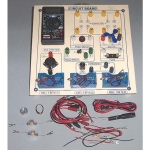
Electrical Circuit Learning Kit
.png)
Product Code : SCL-EAE-11155
The Electrical Circuit Learning Kit is a low-voltage classroom circuit board used for teaching basic electricity, electronics, switching, resistance control, load operation, and circuit protection. It is suitable for school students, physics teachers, STEM labs, science laboratories, distributors, and institutional procurement buyers.
Product Description
The Electrical Circuit Learning Kit from Lab Equipments Ambala is based on the verified Circuit Board Senior product listed under Physics Lab / Electrical and Electronics. The confirmed product code is EL-EAE-10293, and the board is described as single sided.
This kit helps students observe practical circuit behaviour using real components mounted for classroom handling. The verified component set includes a cell holder, buzzer, connectors, fan, fuse, toggle switch, rheostat, bulb holder, and multimeter. The board works on 3 volts DC, making it suitable for supervised low-voltage school experiments.
Key Features
- Low-voltage operation: confirmed working voltage is 3 volts DC.
- Single-sided circuit board: verified board type for clear classroom demonstration.
- Integrated learning components: includes cell holder, buzzer, fan, fuse, switch, rheostat, bulb holder, and multimeter.
- Student-friendly use: designed for school laboratory learning of basic electricity and electronics.
- Visible circuit behaviour: helps students observe switching, load response, resistance control, and fuse protection.
- Physics lab category fit: suitable for Electrical and Electronics practical work.
- Capacity not applicable: this is a circuit learning board, not a measuring vessel.
Technical Specifications
|
Specification |
Detail |
|
Product Name |
Electrical Circuit Learning Kit |
|
Verified Related Product Name |
Circuit Board Senior |
|
Primary Keyword |
Electrical Circuit Learning Kit |
|
Secondary / Semantic Keywords |
school circuit board, 3V DC circuit kit, electricity learning kit, electronics learning board, physics circuit kit, basic electrical circuit trainer, STEM circuit board, school electronics kit |
|
Brand |
Lab Equipments Ambala |
|
Product Category |
Physics Lab / Electrical and Electronics / Circuit Learning Board |
|
Intended Users |
School students, physics teachers, STEM classrooms, science laboratories, laboratory suppliers, distributors, and educational procurement buyers |
|
Capacity |
Not applicable |
|
Board Type |
Single sided |
|
Operating Voltage |
3 volts DC |
|
Included Components |
Cell holder, buzzer, connectors, fan, fuse, toggle switch, rheostat, bulb holder, and multimeter |
What's Included in the Kit
- Single-sided electrical circuit learning board
- Cell holder
- Buzzer
- Connectors
- Fan
- Fuse
- Toggle switch
- Rheostat
- Bulb holder
- Multimeter
- Connecting leads, cells, manual, storage box, worksheet, or certificate
Applications / Uses
- Teaching basic electric circuit construction in school physics labs
- Demonstrating open and closed circuits using a toggle switch
- Showing the operation of loads such as a bulb, buzzer, and fan
- Introducing resistance control through a rheostat
- Explaining fuse protection and safe low-voltage circuit practice
- Using the multimeter for basic voltage, continuity, or circuit-checking demonstrations
How to Use the Electrical Circuit Learning Kit
- Place the circuit board on a clean, dry, stable laboratory bench.
- Insert the required 3V DC power source into the cell holder, if cells are supplied or approved.
- Check that the toggle switch is in the OFF position before making observations.
- Select the component to demonstrate, such as the bulb, buzzer, fan, fuse, or rheostat.
- Close the circuit using the switch and observe the component response.
- Use the rheostat to demonstrate how resistance affects current and load operation.
- Use the multimeter only in the correct mode and range as instructed by the teacher.
- Switch off the board and remove the cells after the activity.
Safety note: Use this kit only with low-voltage 3V DC supply under teacher supervision. Do not connect the board to mains electricity, do not bypass the fuse for student experiments, and keep all terminals dry and clean.
Care & Maintenance
- Store the board in a dry cabinet after use.
- Remove cells before long-term storage to prevent leakage.
- Check the fuse, connectors, switch, and leads before each classroom session.
- Replace damaged wires, loose holders, or faulty components before student use.
Why Choose Lab Equipments Ambala
Lab Equipments Ambala manufactures and exports scientific laboratory instruments, lab experiment setups, science kits, mathematics kits, didactic models, and STEM models. The company’s website states that it was founded in 1982 and supplies scientific and educational equipment for institutions in India and international markets. Its product range includes Physics Lab, Electrical and Electronics, Magnetism, Lab Meters, Chemistry Lab, Biology Lab, Maths Lab, Engineering Lab, and NCERT Kit categories. Buyers can request final specifications before ordering to confirm voltage source, dimensions, manual, spare parts, and packing details.
Frequently Asked Questions
What is an Electrical Circuit Learning Kit used for?
An Electrical Circuit Learning Kit is used to teach basic electricity, electronics, switching, resistance control, load operation, and circuit protection in school physics laboratories.
What voltage does the kit use?
The verified product page states that the circuit board works on 3 volts DC.
What components are included?
The verified component list includes a cell holder, buzzer, connectors, fan, fuse, toggle switch, rheostat, bulb holder, and multimeter.
Is this kit suitable for school students?
Yes. The verified listing states that it is ideal for students in a school laboratory to understand basic principles of electricity and electronics.
Can this kit be connected to mains electricity?
No. It should be used only with the confirmed 3V DC low-voltage supply under teacher supervision. It must not be connected to mains electricity.
For related physics teaching resources, explore Circuit Board Senior, Electrical and Electronics equipment, Physics Lab equipment, and Lab Meters for institutional enquiries.
 (1).png)
 (1).png)
.jpg)
.png)
.jpg)
-Photoroom (1).png)
 (1).png)