
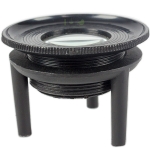
Educational Concave Lens Element
.jpg)
Product Code : SCL-LAO-11294
The Educational Concave Lens Element is a diverging optical component used to demonstrate how parallel light rays spread after passing through a concave lens. It supports classroom and laboratory experiments involving negative focal length, virtual image formation, ray tracing and basic geometrical-optics principles.
Product Description
A concave lens is thinner at its optical centre than at its edges. When a parallel beam passes through the lens, the outgoing rays diverge and appear to originate from a virtual focal point on the incident-light side. This behaviour makes the element suitable for comparing converging and diverging lenses.
The lens can be positioned in a compatible holder, optical bench or ray-tracing arrangement. Its exact form—double concave, plano-concave or another negative-lens profile—must be confirmed. Material, focal length, diameter, optical power and dimensional tolerances are also product-specific procurement details.
Key Features
- Diverging lens action: Spreads parallel or converging rays after transmission through the lens.
- Negative focal length: Supports instruction on virtual focal points and negative optical power.
- Ray-tracing compatibility: Can be used with a ray box, laser ray source or other suitable narrow-beam system.
- Virtual image demonstration: Helps learners examine upright, diminished virtual images formed by a concave lens.
- Bench-compatible format: Can be mounted in a correctly sized optical holder or carrier.
- Reusable teaching element: Suitable for repeated supervised practicals and classroom demonstrations.
- No electrical requirement: The lens itself requires no power; a separate light source may be used.
Technical Specifications
|
Specification |
Detail |
|
Product name |
Educational Concave Lens Element |
|
Brand |
Lab Equipments Ambala |
|
Product category |
Diverging Lens / Educational Optics Component |
|
Lens action |
Diverging |
|
Lens profile |
Concave; exact double-concave or plano-concave form |
|
Focal-length sign |
Negative under the standard Cartesian sign convention |
What's Included
- One Educational Concave Lens Element
- Protective storage case or wrapping
- Lens holder or mounting frame
- Focal-length identification label
- Experiment or care instructions
Applications
- Observing the divergence of parallel light rays.
- Locating the virtual principal focus by ray tracing.
- Studying virtual, upright and diminished image formation.
- Comparing concave and convex lens behaviour.
- Investigating compound lens arrangements.
- Supporting optical-bench, ray-box and classroom demonstrations.
Related products include the Acrylic Lens and Prism set, the Ray Optics Kit, the complete Light and Optics range and broader Physics Laboratory Equipment.
How to Use the Educational Concave Lens Element
- Inspect the lens and clean both optical surfaces.
- Secure it in a compatible lens holder without overtightening.
- Align the lens centre with the light source and optical axis.
- Direct parallel or narrow rays through the lens.
- Trace the diverging rays after they leave the lens.
- Extend the outgoing rays backward to locate the virtual focus.
- Record the ray paths and compare them with the predicted diagram.
Safety note: Handle the lens by its edge. Do not use chipped components, and never direct a laser or concentrated light beam toward the eyes.
Care & Maintenance
- Clean the lens using a soft, lint-free optical cloth.
- Avoid touching the optical surfaces with bare fingers.
- Do not use abrasive cleaners or overtighten the mounting holder.
- Store the lens separately in padded, dry packaging.
Why Choose Lab Equipments Ambala
Lab Equipments Ambala manufactures and supplies physics apparatus, educational optical components and laboratory experiment kits from Ambala, India. Its published optics range includes concave and convex lenses, prisms, ray-optics kits, optical benches and related holders. The company supplies educational and institutional laboratories. Buyers should request the confirmed lens profile, focal length, diameter and material specification before ordering.
Frequently Asked Questions
What is an Educational Concave Lens Element used for?
It is used to demonstrate diverging light rays, negative focal length and virtual image formation.
Does a concave lens converge or diverge light?
A standard concave lens diverges parallel incident rays, making them appear to originate from a virtual focal point.
What image does a concave lens form?
For a real object, an isolated concave lens normally forms a virtual, upright and diminished image.
Is the lens double concave or plano-concave?
The precise lens profile is not confirmed. It should be stated in the technical drawing or product packing list.
What is its focal length?
The focal length is not published for this exact element. Confirm both its nominal value and tolerance before procurement.
Can it be used on an optical bench?
Yes, provided the lens diameter and mounting arrangement match the intended holder or optical-bench carrier.
Request the confirmed lens diameter, profile, focal length and optical material, or explore the Light and Optics equipment category for related educational lenses.

.png)
.jpg)
.jpg)

.jpg)
.png)