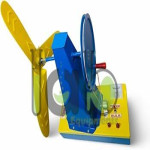
Functional Windmill Training Model
.png)
Product Code : SCL-PMP-11361
The Functional Windmill Training Model is a renewable energy educational model used for demonstrating how moving air rotates windmill blades and converts wind energy into mechanical motion. It is designed for schools, colleges, STEM labs, physics laboratories, environmental science classrooms, engineering basics lessons, and science exhibitions.
Product Description
The Functional Windmill Training Model by Lab Equipments Ambala is a practical teaching model for explaining wind energy, blade movement, rotor action, rotational motion, and basic mechanical energy conversion. It helps students observe how airflow strikes the blades and produces rotation in a wind-powered system.
Lab Equipments Ambala lists this product as Windmill Model with product code SCL-PMP-11108. The verified listing positions it for classroom, laboratory, STEM, and science-exhibition use. Exact material, blade size, tower height, electrical output capability, dimensions, and supplied accessories should be confirmed from the final datasheet before publication or procurement.
Key Features
- Demonstrates wind energy conversion through visible blade and rotor movement.
- Supports teaching of renewable energy, rotational motion, airflow, blade action, and mechanical energy conversion.
- Useful for physics labs, environmental science classes, STEM classrooms, and science exhibitions.
- Helps students observe how wind direction and airflow strength affect windmill rotation.
- Suitable for teacher-led demonstrations, project work, and supervised student observation.
- Provides a classroom-friendly way to explain wind-powered systems without full-scale equipment.
- Designed for educational use in schools, colleges, universities, and training laboratories.
Technical Specifications
|
Specification |
Detail |
|
Product name |
Functional Windmill Training Model |
|
Also listed as |
Windmill Model |
|
Brand |
Lab Equipments Ambala |
|
Product category |
Renewable Energy Demonstration Model / Physics Demonstration Model / STEM Teaching Aid |
|
Primary keyword |
functional windmill training model |
|
Secondary keywords |
windmill model, wind energy model, renewable energy model, wind turbine teaching model, rotational motion model, STEM wind energy kit, school physics lab equipment, environmental science teaching aid |
|
Intended users |
Schools, colleges, universities, STEM labs, physics teachers, environmental science programs, engineering basics labs, and student project groups |
|
Demonstration capacity |
Classroom and laboratory demonstration capacity; exact output capability to be confirmed |
|
Working principle |
Moving air strikes the windmill blades and causes rotor rotation, converting wind energy into rotational motion |
|
Operation |
Manual classroom and laboratory demonstration setup |
|
Construction |
Educational-grade model with blade assembly, support tower, rotor arrangement, and demonstration base |
What's Included in the Kit
- Functional windmill training model main assembly
- Blade assembly or rotor
- Support tower or vertical stand
- Demonstration base or mounting platform
- Shaft, hub, or rotor support arrangement
- Output indicator, lamp, meter, or generator section, if supplied
- User manual, experiment guide, or activity sheet
- Storage box or packing case
Applications / Uses
- Demonstrating wind energy conversion in school and college physics laboratories.
- Teaching how moving air produces blade rotation and mechanical motion.
- Explaining renewable energy systems in environmental science lessons.
- Supporting STEM projects on clean energy, turbine design, and sustainability.
- Helping students compare blade movement under different airflow directions and strengths.
- Using as a working display model for science fairs and classroom exhibitions.
- Introducing basic engineering concepts such as rotor motion, shaft movement, and energy transfer.
How to Use the Functional Windmill Training Model
- Place the windmill model on a stable classroom table or demonstration bench.
- Check that the blade assembly, shaft, tower, and base are secure before use.
- Position the model in front of a controlled airflow source, such as a classroom fan, if permitted by the manual.
- Start with low airflow and observe the blade rotation.
- Change the direction or strength of airflow and compare the effect on rotor speed.
- If the model includes an output indicator, observe the lamp, meter, LED, or generator response.
- Ask students to identify the energy changes from wind energy to rotational mechanical energy.
- Stop the airflow fully before touching, adjusting, or moving the windmill model.
Use the model only under teacher supervision. Keep fingers, loose clothing, hair, paper, and wires away from moving blades, and do not apply excessive airflow or connect unapproved electrical loads.
Care & Maintenance
- Wipe the blades, tower, base, and rotor area with a soft, dry cloth after use.
- Store the model in a dry cabinet to protect the blade assembly, shaft, labels, and base.
- Keep the moving parts free from dust, obstruction, bending, and impact.
- Inspect blade alignment, shaft movement, base stability, and any output terminals before each demonstration.
Why Choose Lab Equipments Ambala
Lab Equipments Ambala lists the Windmill Model with product code SCL-PMP-11108 in its physics product catalogue. The company manufactures and supplies educational laboratory equipment, scientific laboratory instruments, science kits, mathematics kits, didactic models, and STEM learning products for institutional buyers. Its catalogue includes physics lab equipment, renewable-energy models, electrical and electronics products, laboratory instruments, NCERT kits, and educational demonstration models. Buyers should request the final datasheet, component list, warranty terms, and compliance documents before bulk orders, tenders, or institutional procurement.
Explore related categories such as educational laboratory equipment, physics lab equipment, physics miscellaneous products, and Hydro Power Model.
Frequently Asked Questions
What is a Functional Windmill Training Model used for?
A Functional Windmill Training Model is used to demonstrate how moving air can rotate windmill blades and convert wind energy into rotational mechanical motion. It is used in physics, STEM, environmental science, and renewable energy lessons.
How does the Functional Windmill Training Model work?
The model works when moving air strikes the blade assembly and causes the rotor to turn. This visible rotation helps students understand how wind-powered systems convert airflow into mechanical motion.
Is this model suitable for school science labs?
Yes, the model is suitable for school science labs, college laboratories, STEM classrooms, and science exhibitions when used under teacher supervision.
Does the windmill model generate electricity?
The verified listing describes wind energy, rotational motion, renewable power generation, and mechanical energy conversion principles. The exact electrical output function must be confirmed from Lab Equipments Ambala before publishing generator or voltage claims.
What concepts can students learn from this model?
Students can learn wind energy, blade rotation, rotor motion, airflow effect, renewable energy conversion, mechanical energy transfer, and basic environmental science principles.
What material is the Functional Windmill Training Model made of?
The material was not verified from public product data. Confirm the blade material, tower construction, base material, shaft arrangement, output indicator, and finish from Lab Equipments Ambala before publishing final specifications.
For more renewable energy and physics demonstration models, visit the physics miscellaneous products category by Lab Equipments Ambala.
Suggested image ALT text: Functional Windmill Training Model for classroom wind energy and blade rotation demonstration by Lab Equipments Ambala.
.png)

.jpeg)