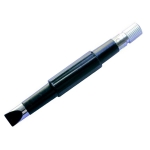
Telegraph Tapping Key
.jpg)
Product Code : SCL-EAE-11259
The Telegraph Tapping Key is a manually operated electrical switch used to make and break a low-voltage circuit for Morse-code and communication demonstrations. It enables students to create short and long electrical pulses while studying circuit control, signal transmission and the operating principle of an electrical telegraph.
Product Description
The apparatus uses a movable lever and electrical contact arrangement. Pressing the operating knob brings the contacts together and closes the circuit. Releasing the lever separates the contacts and interrupts current flow. This repeated switching produces the electrical pulses required for coded signalling.
The key can be connected to a compatible buzzer, telegraph sounder, lamp or other low-voltage indicator. Its visible mechanical action helps students relate manual input to circuit switching and transmitted signals within an electrical and electronics laboratory.
Key Features
- Make-and-break operation: Opens and closes an electrical circuit through manual tapping.
- Lever-operated mechanism: Provides direct control over the duration of each signal.
- Morse-code demonstrations: Produces short and long pulses representing dots and dashes.
- Low-voltage laboratory use: Connects to compatible educational signalling circuits.
- Accessible terminals: Allows connection to a power source and receiving device, subject to the confirmed model.
- Reusable apparatus: Suitable for repeated supervised classroom activities.
- Visible switching principle: Helps learners observe how mechanical contact controls current flow.
Technical Specifications
|
Specification |
Detail |
|
Product name |
Telegraph Tapping Key |
|
Product type |
Manual make-and-break electrical key |
|
Primary application |
Morse-code and telegraph-circuit demonstrations |
|
Switching action |
Momentary contact |
What's Included in the Kit
- 1 × Telegraph Tapping Key
A battery, power supply, buzzer, sounder, lamp, connecting leads and receiving telegraph unit are not included unless specifically stated.
Applications / Uses
- Demonstrating manual make-and-break electrical switching.
- Sending Morse-code dots and dashes through a classroom circuit.
- Operating a compatible buzzer, sounder or indicator lamp.
- Comparing short and long electrical signal pulses.
- Constructing a basic wired communication system between two stations.
- Explaining the historical operating principle of electrical telegraphy.
- Supporting experiments in the physics laboratory equipment range.
How to Use the Telegraph Tapping Key
- Confirm the key’s permitted voltage and current rating.
- Keep the low-voltage power source switched off while wiring the circuit.
- Connect the key in series with the power source and receiving device.
- Check that the lever moves freely and the contacts separate when released.
- Switch on the power source at its minimum suitable setting.
- Press and release the key briefly to produce a dot signal.
- Hold the key down longer to produce a dash signal.
- Practice sending letters using an approved Morse-code chart.
- Switch off the supply before adjusting the contacts or connections.
Safety note: Use only a compatible, current-limited, low-voltage educational supply. Never connect the tapping key directly to mains electricity.
Care & Maintenance
- Keep the electrical contacts clean, dry and properly aligned.
- Do not strike the lever or apply excessive downward pressure.
- Store the apparatus away from moisture and corrosive chemicals.
- Disconnect the circuit before adjusting contact spacing or spring tension.
Why Choose Lab Equipments Ambala
Lab Equipments Ambala manufactures and exports scientific and educational laboratory equipment from Ambala, India. Its range includes physics apparatus, electrical teaching equipment, circuit accessories and STEM demonstration models. The company supports institutional procurement and international equipment supply. Buyers should confirm the tapping key’s construction, terminals and electrical rating before ordering.
Frequently Asked Questions
What is a Telegraph Tapping Key used for?
It is used to open and close an electrical circuit manually and to generate coded pulses for Morse-code demonstrations.
How does a telegraph key create dots and dashes?
A brief press produces a short pulse or dot. Holding the lever down longer produces a longer pulse or dash.
Does the tapping key generate sound by itself?
Not necessarily. It normally requires a compatible buzzer, sounder or other receiving device to provide an audible or visible response.
Can two tapping keys be used for communication?
Two suitable stations can be arranged for classroom communication when connected with compatible receiving devices and a correctly designed circuit.
Is the contact gap adjustable?
Many telegraph keys provide contact-gap or tension adjustment, but these features must be confirmed for the supplied model.
Can the key be connected to mains electricity?
No. It must be used only with a suitable current-limited, low-voltage laboratory circuit under qualified supervision.
Explore the electrical and electronics laboratory equipment range, review the school electromagnetism laboratory guide, or contact Lab Equipments Ambala to confirm product specifications and institutional supply options.
 (1).png)
.png)
.jpg)
.jpg)
.jpeg)