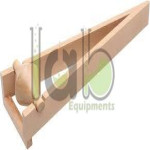
Frequency Resonance Strip Model
 (1).png)
Product Code : SCL-PMP-11306
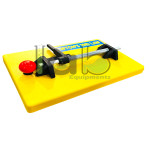
The Frequency Resonance Strip Model is an educational physics apparatus used to demonstrate natural frequency, forced vibration and selective resonance. It allows students and teachers to observe how flexible strips with different physical characteristics respond differently when the supporting structure is excited.
Product Description
The model typically consists of several flexible strips or reeds fixed to a common support. Differences in strip length, stiffness, thickness or mass give each element a different natural frequency. When the base is vibrated, the strip whose natural frequency is closest to the driving frequency develops the largest visible amplitude.
This direct comparison helps learners distinguish ordinary forced vibration from resonance. The apparatus can support qualitative lessons on natural frequency, amplitude, damping and frequency response. The exact strip quantity, material, dimensions, frequency values, excitation mechanism and mounting arrangement must be confirmed for the supplied model.
Key Features
- Selective resonance display: Shows one strip responding more strongly when the driving frequency approaches its natural frequency.
- Multiple vibrating elements: Allows simultaneous comparison of strips with different resonance characteristics.
- Visible amplitude change: Makes the increase in oscillation near resonance easy to observe.
- Forced-vibration demonstration: Illustrates how an external periodic force drives an oscillating system.
- Natural-frequency comparison: Helps explain why length, stiffness and mass affect vibration response.
- Reusable teaching model: Suitable for repeated classroom demonstrations, laboratory lessons and science exhibitions.
- Manual or driven operation: Excitation may be applied manually or through a supplied vibrator; exact method.
Technical Specifications
|
Specification |
Detail |
|
Product name |
Frequency Resonance Strip Model |
|
Brand |
Lab Equipments Ambala |
|
Product category |
Resonance and Forced-Vibration Demonstration Model |
|
Scientific principles |
Natural frequency, forced vibration, resonance, amplitude and damping |
What's Included
- Frequency resonance strip assembly
- Flexible strips or reeds
- Common support frame and base
- Manual exciter, vibrator or drive unit
- Frequency scale or identification labels
- Power supply and connecting leads
- Teacher demonstration guide
Applications
- Demonstrating natural frequency in flexible mechanical elements.
- Comparing forced vibration and resonant vibration.
- Observing increased amplitude near resonance.
- Studying the effects of strip length, stiffness and mass.
- Introducing damping and frequency-response concepts.
- Supporting physics lessons, STEM projects and science exhibitions.
Related equipment includes the Tuning Fork Set of 8, the Transverse Wave Pendulum Apparatus, the Physics Miscellaneous Products range and broader Physics Laboratory Equipment.
How to Use the Frequency Resonance Strip Model
- Place the model on a stable laboratory or demonstration table.
- Inspect the strips and confirm that none are bent or obstructed.
- Identify the individual strips or their marked frequency values.
- Apply gentle periodic excitation using the supplied operating method.
- Change the driving frequency gradually where adjustment is available.
- Observe which strip develops the greatest vibration amplitude.
- Record the driving condition and corresponding resonant strip.
- Repeat the demonstration to compare other strips and frequencies.
Safety note: Keep fingers, hair and loose clothing clear of moving strips and drive components. Switch off powered excitation before adjusting the strips or support frame.
Care & Maintenance
- Do not bend, twist or permanently deform the resonance strips.
- Keep the clamping points secure without overtightening them.
- Remove dust using a soft, dry cloth.
- Disconnect powered components before cleaning or storage.
Why Choose Lab Equipments Ambala
Lab Equipments Ambala manufactures and supplies educational physics apparatus, sound equipment and vibration demonstration systems from Ambala, India. Its published range includes tuning forks, transverse-wave apparatus and equipment for resonance and oscillation experiments. The company supplies schools, colleges, universities and institutional laboratories. Buyers should request the strip specification, frequency data and component-level packing list before ordering.
Frequently Asked Questions
What is a Frequency Resonance Strip Model used for?
It is used to demonstrate natural frequency, forced vibration and the large-amplitude response that occurs near resonance.
Why do different strips vibrate differently?
Differences in length, stiffness, thickness and mass give the strips different natural frequencies.
What happens at resonance?
The strip whose natural frequency is close to the driving frequency absorbs energy efficiently and develops a larger vibration amplitude.
Are the strip frequencies marked?
Frequency markings have not been confirmed for this exact model. Request the natural-frequency values and permitted tolerance before procurement.
Does the model require electricity?
A manual model requires no power. Electrical requirements depend on whether an electromagnetic or motor-driven exciter is supplied.
Is it suitable for school physics laboratories?
Yes. It is suitable for supervised senior-school and introductory college lessons on oscillation, forced vibration and resonance.
Request the confirmed strip count, materials, natural frequencies and excitation method, or explore the Physics Miscellaneous Products category for related vibration apparatus.
.png)